Culver Mobility
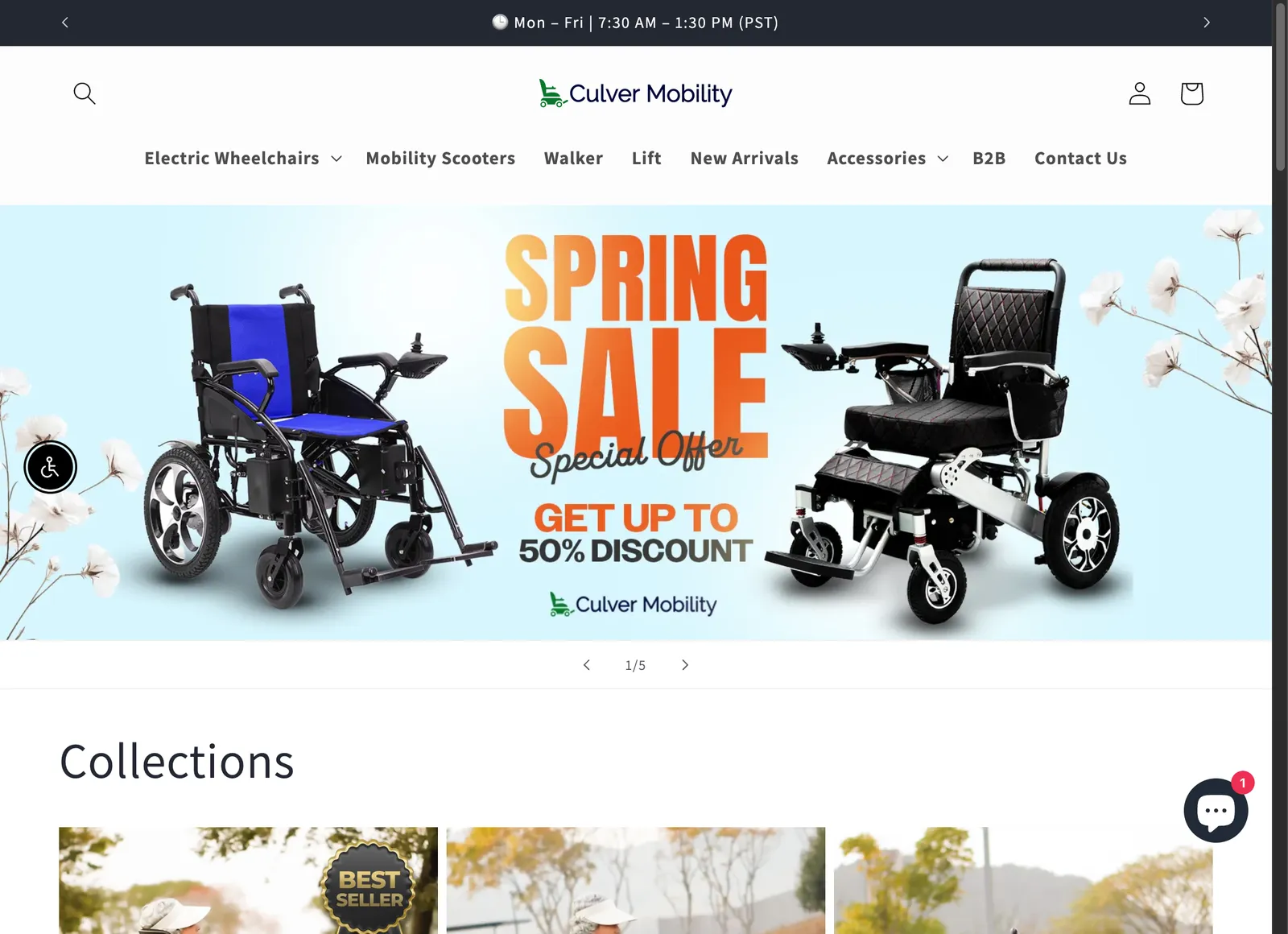
Culver Mobility sells folding electric wheelchairs and mobility scooters direct from the factory, which meant the store had to make weight, range, and fit easy to compare for shoppers who buy once and need to get it right.
The brief
Culver Mobility's catalog spans named models like Kano, Wolf, Shawk, Artemis, Cobra, and Panther, each with different weight capacities, folding weights, and ranges. Shoppers (often buying for themselves or a parent) compare carbon fiber, heavy-duty, lightweight, and reclining options, then need accessories that fit their exact chair. The store also runs a separate B2B channel and financing, so one template could not serve every buyer.
- Buyers weigh portability (a 30 lb folding Kano) against range and capacity (a 330 lb, 13-mile Wolf), so specs had to be scannable, not buried in description text
- Accessories are model-specific (Artemis, Cobra, Kano, Wolf, Panther), making mismatched-part orders a real support and returns risk
- Trust signals (free shipping, no sales tax, fully assembled, factory pricing, financing) needed to be visible without cluttering a chair's purchase decision
What I built
Gencer Karakaya built a fully custom Shopify theme around the way mobility equipment is actually shopped. Each electric wheelchair gets a structured spec block driven by metafields (folding weight, capacity, range, foldability, frame material), so a Kano, Wolf, or Shawk reads consistently. Collection pages for carbon fiber, lightweight, heavy-duty, and reclining filter on those same fields, and accessories are tied to their parent model so customers only see parts that fit.
- Metafield-backed spec panels and Liquid-rendered comparison cues so capacity, folding weight, and range line up across every model
- Model-aware accessory logic that surfaces only Artemis, Cobra, Kano, Wolf, or Panther compatible parts on each product page
- Financing (0% interest, 12 months same-as-cash) and the free-shipping / no-sales-tax / fully-assembled messaging integrated into PDP and cart without slowing the page
- Clean separation between the retail storefront and the b2b.culvermobility.com channel so wholesale buyers and individual shoppers each get the right experience
FAQ
How are the different wheelchair models kept consistent and comparable on the site?
Each model's specs (folding weight, weight capacity, range, frame material, foldability) are stored as Shopify metafields and rendered through Liquid into a uniform spec panel. That way a 30 lb Kano and a 330 lb Wolf present the same data points, so shoppers can compare at a glance.
How does the store prevent customers from ordering accessories that don't fit their chair?
Accessories are linked to their parent models in the catalog, so product and collection pages only surface parts compatible with that specific chair (Artemis, Cobra, Kano, Wolf, Panther). This reduces mismatched orders, returns, and support tickets.
Was this a theme from the store or a custom build?
It is a custom Shopify theme built by Gencer Karakaya. The spec system, model-aware accessory matching, financing and trust messaging, and the retail / B2B split are tailored to how mobility equipment is sold rather than dropped in from a generic template.